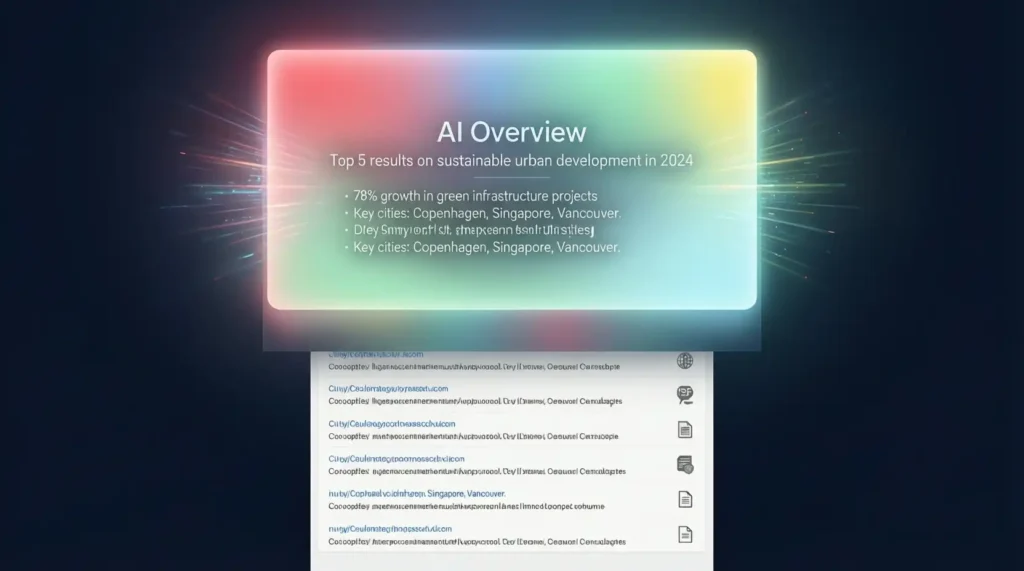
The era of “Ten Blue Links” is officially over. If you’ve searched for anything complex lately, like “how to fix a leaky faucet” or “best budget laptops for coding”, you’ve likely seen it: a massive, shaded block of text dominating the top of the screen. It pushes organic results down, answers the user’s question immediately, and changes the game for SEOs and content creators alike.
This is the Google AI Overview (formerly known as SGE). And if you want to survive in the search landscape of 2026, you cannot ignore it.
🚀 Key Takeaways
- Definition: Google AI Overviews are AI-generated summaries that appear at the top of search results, powered by the Gemini model.
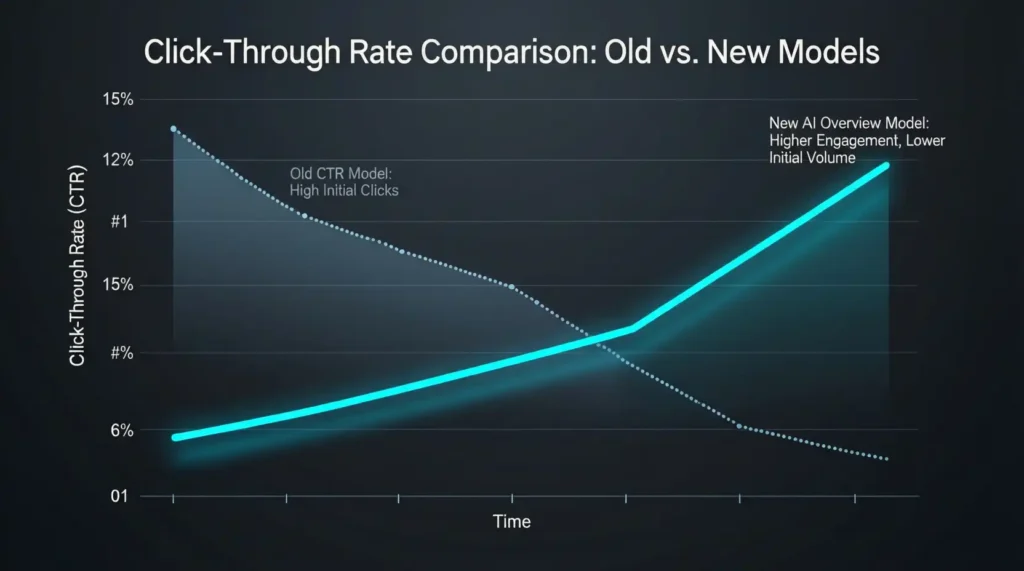
- The Impact: Informational queries have seen organic Click-Through Rates (CTR) drop by 30-60% since rollout.
- The Strategy: Traditional SEO is shifting to GEO (Generative Engine Optimization)—optimizing for “Answer Engines” rather than just search engines.
- The Goal: You are no longer fighting for a click; you are fighting to be cited as a source within the AI’s answer.
What Is a Google AI Overview?
A Google AI Overview is a generative search experience that synthesizes information from multiple web sources to provide a direct, comprehensive answer to a user’s query. Unlike traditional search results, which act as a directory pointing you to other websites, an AI Overview acts as a librarian who reads the books for you and summarizes the answer.
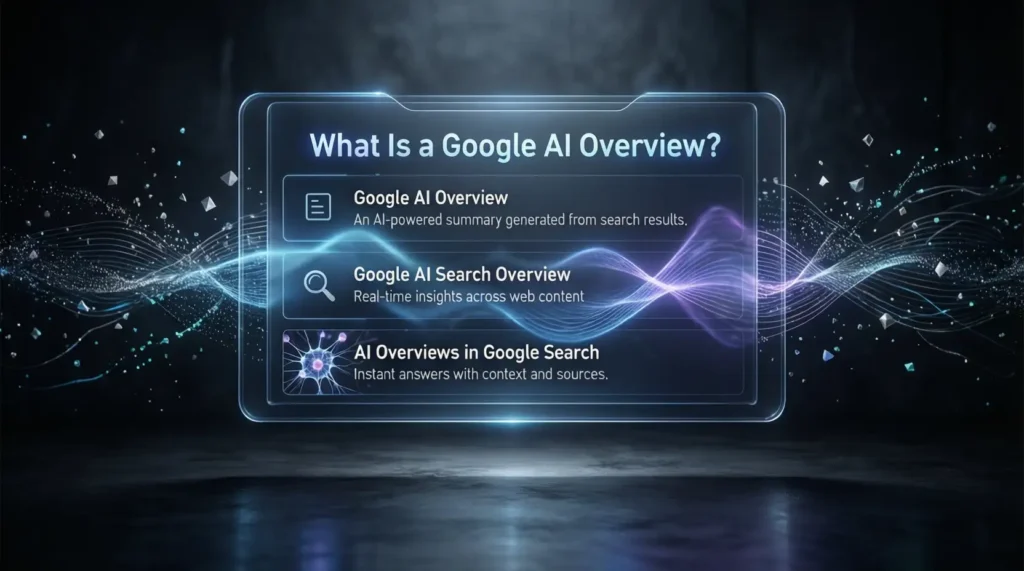
Powered by Google’s advanced Gemini models, these overviews are designed to handle complex, multi-step queries. For example, if you ask, “What’s the difference between a Roth IRA and a 401k, and which is better for a freelancer?”, the AI won’t just give you a link to a bank. It will:
- Define both terms.
- Compare them in a table or list.
- Contextualize the answer specifically for a “freelancer” (noting contribution limits and tax implications).
- Cite 3-5 sources via clickable “link cards” or expansion toggles.
The Evolution: From SGE to Mainstream
You might remember this feature as SGE (Search Generative Experience). It started as an opt-in experiment in Google Labs. By mid-2024 and entering 2025, Google stripped the “experimental” tag and rolled it out globally. Today, it is the default experience for a vast majority of informational searches in the US, UK, and beyond.
AI Overviews vs. Featured Snippets: What’s the Difference?
Many beginners confuse AI Overviews with Featured Snippets (Position Zero). While they occupy the same visual space, they function very differently.
| Feature | Featured Snippet | AI Overview |
|---|---|---|
| Mechanism | Extraction: Google copies a paragraph verbatim from one webpage. | Synthesis: Google’s AI reads 5-10 pages and writes a new answer. |
| Sources | Single source (Winner takes all). | Multiple sources (3+ links cited). |
| Click Potential | High (Users click to read more). | Lower (Answer is often complete; “Zero-Click”). |
| Query Type | Simple definitions (“What is SEO?”). | Complex/Nuanced (“How does SEO impact brand equity?”). |
The SEO Impact: The “Zero-Click” Reality
Let’s look at the hard numbers. The introduction of AI Overviews has accelerated the trend of “Zero-Click Searches”—where a user gets their answer without ever visiting a website.
Recent data from 2025 impact studies paints a stark picture:
- CTR Decline: Websites ranking in Position 1 have seen a CTR drop of roughly 34.5% for informational queries when an AI Overview is present.
- Informational vs. Transactional: The impact is heaviest on “What is” and “How to” queries. Transactional queries (e.g., “Buy Nike running shoes”) are less affected, as the AI often defers to shopping listings.
- The “Web” Filter: In response to backlash, Google introduced a “Web” filter tab that allows users to strip away AI features. While power users love this, the average user sticks to the default AI view.
“You are no longer optimizing for traffic volume. You are optimizing for traffic quality. The users who click through an AI Overview are deeper in the funnel and looking for expert validation, not just basic facts.”
GEO: How to Optimize for AI Overviews (The Skyscraper Strategy)
If you want to rank in these overviews, you need to stop thinking about SEO (Search Engine Optimization) and start thinking about GEO (Generative Engine Optimization). The goal is to convince the Gemini model that your content is the most authoritative, structured, and “fluent” source to cite.
Here is your 3-step battle plan for 2026.
1- The “Direct Answer” Protocol
AI models are lazy. They prefer content that is easy to parse. Do not bury your answer behind 500 words of fluff.
- The 30-Word Rule: Immediately after a heading (like “How to clean a cast iron skillet”), provide a direct, bolded answer in 30-50 words.
- Format for Robots: Use bullet points, numbered lists, and comparison tables. AI Overviews love structured data because it is easy to synthesize.
2- Optimize for “Information Gain”
If your article says the exact same thing as the top 10 results, the AI has no reason to cite you. You need Information Gain—unique data or perspectives that don’t exist elsewhere.
Example: Instead of just listing “Top 10 Coffee Makers,” include a section on “The Noise Level of Each Machine in Decibels.” This unique data point makes your content a primary source that the AI must reference for a complete answer.
3- Boost Your “Entity Authority”
Google’s AI connects entities (concepts, people, brands). It trusts sources that demonstrate deep expertise.
- Author Bios: Ensure every article has a robust author bio linking to LinkedIn or other publications.
- Citations: Link out to high-authority research. Paradoxically, linking to trusted sources helps the AI trust you more.
- Brand Mentions: The more your brand is mentioned in forum discussions (Reddit, Quora) and news sites, the more likely the AI is to “know” you are a valid entity.
How to Track Your AI Overview Performance
As of 2026, Google Search Console has begun rolling out specific metrics for AI visibility, but it is still imperfect. Here is how to track it manually:
- Rank Tracking Tools: Tools like Semrush and Ahrefs now have “SERP Feature” filters. Filter by “AI Overview” to see which of your keywords trigger one.
- CTR Correlation: If you maintain a #1 ranking but see a sudden 40% drop in clicks, it is highly likely an AI Overview has appeared for that term.
- Referral Traffic: Watch for traffic coming from
google.comwith specific URL parameters that indicate an AI expansion click.
The Future: Multimodal and Voice
The AI Overview is not just text. We are seeing a rapid shift toward Multimodal Search. This means the AI can “see” images and “listen” to video.
If you have a video on YouTube titled “How to tie a tie,” Google’s AI can now “watch” that video, extract the steps, and list them in the AI Overview, citing your video as the source. Video SEO is no longer optional—it is a backdoor into the AI Overview for competitive keywords.
FAQ: Common Questions About Google AI Overviews
Can I opt out of Google AI Overviews?
As a user, you can use the “Web” filter tab to see text-only results. As a website owner, you can use the nosnippet tag, but this is a “nuclear option” that will also remove you from Featured Snippets and likely tank your organic traffic. It is generally better to optimize for it than to hide from it.
Does AI Overview steal my content?
Legally, it’s a gray area. Technically, it “synthesizes” facts, which aren’t copyrightable. However, Google argues that it drives traffic by providing citation links. The reality is that it does reduce clicks for simple queries, but can drive higher-qualified leads for complex ones.
How do I know if I am cited in an AI Overview?
Currently, there is no perfect “AI Overview Report” in GSC. You must rely on third-party tracking tools or manual spot-checks of your top keywords to see if your link appears in the “carousel” or expansion cards within the overview.

- What Is a Google AI Overview? The SEO Survival Guide (2026) - February 3, 2026
- How Search Engines Use AI to Rank Content: The 2026 Deep Dive - January 27, 2026
- What Is AI SEO? The Complete Guide to Ranking in AI-Powered Search (2025) - December 21, 2025
Give me the latest news!
Looking for SEO tips? Subscribe to our newsletter to receive updates on the content you care about.