AI SEO is the process of optimizing content so it can be understood, selected, and cited by AI-powered search systems.
Instead of focusing only on keyword rankings, AI SEO helps your content appear in Google AI Overviews, Bing Copilot, and other generative search results by providing clear answers, strong entity context, and trustworthy information.
In simple terms, AI SEO helps search engines use your content to answer questions directly, not just list your page as a link.
Search engine optimization has changed. A lot.
Search engines no longer just scan keywords and links.
They now use artificial intelligence (AI) to understand meaning, intent, and context. They summarize answers, power voice search, and generate AI Overviews directly on the results pageThis shift has created a new way of optimizing content called AI SEO.
In this guide, you’ll learn what AI SEO is, how it works, why it matters in 2025, and how to optimize your content for AI Overviews, featured snippets, and generative search engines.If you want your content to be visible in the future of search, this is where you start.
How AI SEO Is Different from Traditional SEO
Traditional SEO focused on ranking pages.
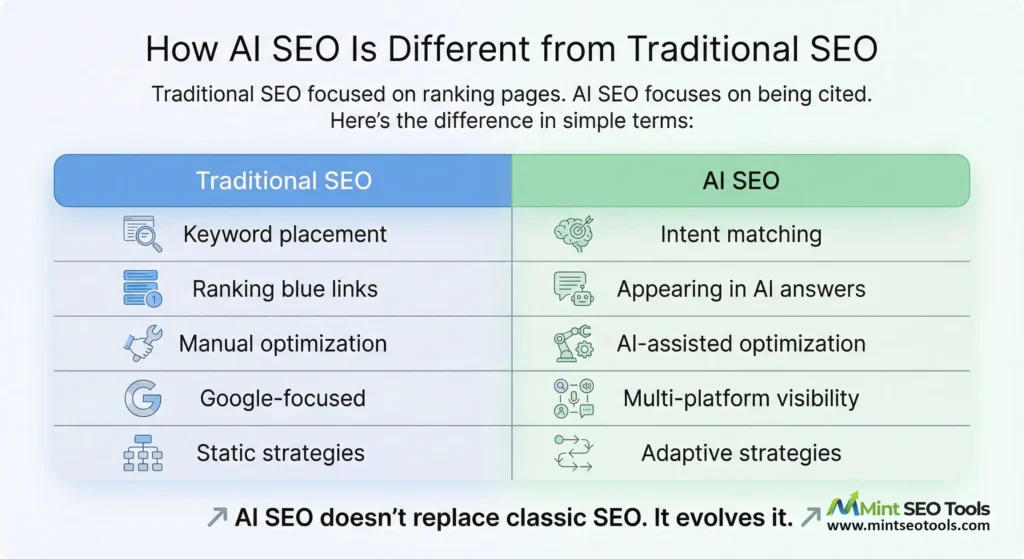
AI SEO focuses on being cited.
Here’s the difference in simple terms:
| Traditional SEO | AI SEO |
|---|---|
| Keyword placement | Intent matching |
| Ranking blue links | Appearing in AI answers |
| Manual optimization | AI-assisted optimization |
| Google-focused | Multi-platform visibility |
| Static strategies | Adaptive strategies |
AI SEO doesn’t replace classic SEO.
It evolves it.
Why AI SEO Matters in 2026
Search behavior has changed, and AI is the reason.
1- AI Overviews and Answer Engines Are Taking Over
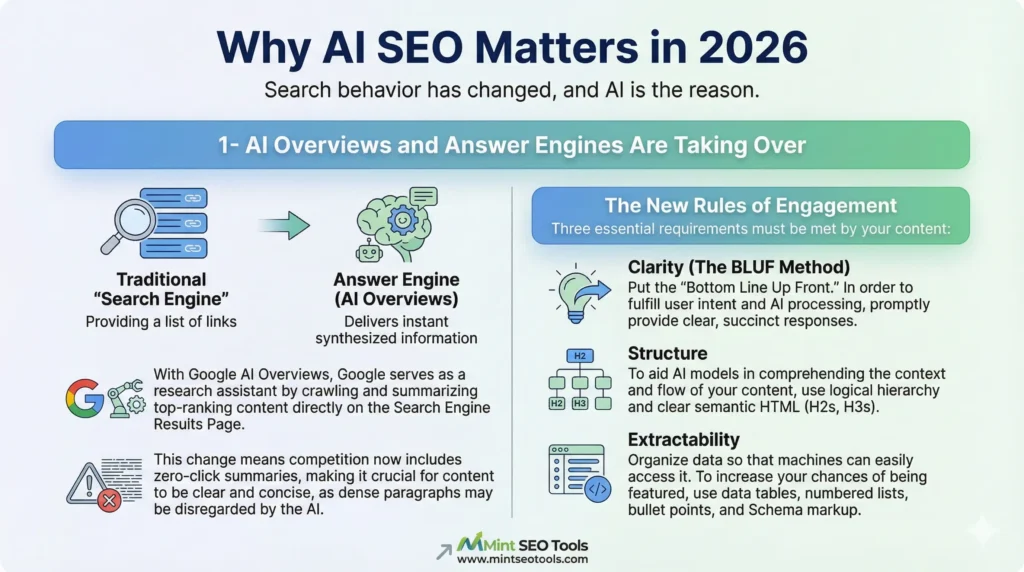
The nature of Google Search has evolved from a traditional “Search Engine”. Providing a list of links to an “Answer Engine” that delivers instant synthesized information.
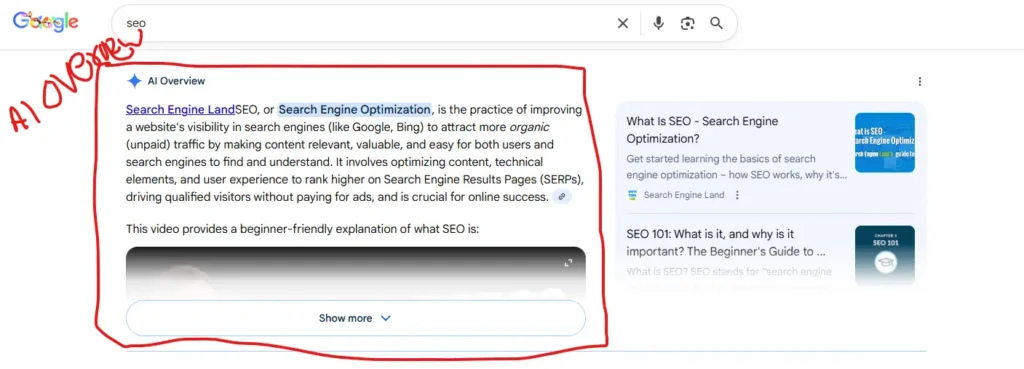
With Google AI Overviews, Google serves as a research, assistant by crawling and summarizing top-ranking content directly on the Search Engine Results Page.
This change means competition now includes zero-click summaries, making it crucial for content to be clear and concise, as dense paragraphs may be disregarded by the AI.
The New Rules of Engagement
Three essential requirements must be met by your content:
- The BLUF Method of Clarity: Put the “Bottom Line Up Front.” In order to fulfill user intent and AI processing, promptly provide clear, succinct responses.
- Structure: To aid AI models in comprehending the context and flow of your content, use logical hierarchy and clear semantic HTML (H2s, H3s).
- Extractability: Organize data so that machines can easily access it. To increase your chances of being featured, use data tables, numbered lists, bullet points, and Schema markup.
2- Search Has Shifted from Keywords to Intent
The era of obsessive “keyword density” is definitively over.
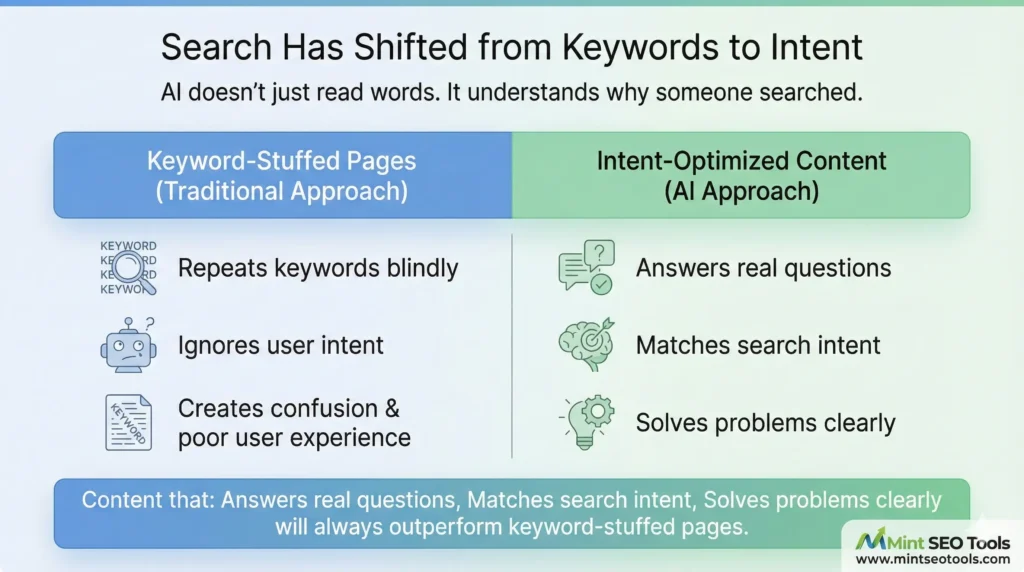
Modern search engines, leveraging AI models such as BERT and MUM, have evolved to focus on understanding human context rather than just matching text.
This shift towards Semantic Search allows Google to analyze the user’s underlying motivation or Search Intent. If content does not meet this motivation quickly, users may return to search results, indicating to Google that the page is irrelevant.
In order to succeed in this setting, you must shift from focusing on keywords to meeting the four essential pillars of intent:
- Informational: They want an answer or a guide.
- Commercial Investigation: They are comparing options before buying.
- Transactional: They are ready to purchase or download right now.
- Navigational: They are looking for a specific website.
The New Standard for Optimized Content
You cannot serve a sales page to someone with a purely educational question. Success relies on aligning your content format directly with the user’s desired outcome.
In the AI era, winning content:
- Answers real questions using natural, conversational language.
- Matches the stage of the journey, providing the right depth for beginner vs. expert.
- Solves the comprehensive problem instead of just defining it.
The algorithm is now smart enough to know when you are writing for robots instead of humans. Genuinely helpful, intent-aligned pages will systematically outperform keyword-stuffed content.
3- Zero-Click Searches Are Increasing
The definition of a “successful search” has fundamentally changed. We have entered the era of the Zero-Click Search.
Data from 2025 reveals that approximately 60% of all Google searches now end without a click to an external website. Users are no longer looking for a list of links; they are looking for immediate answers, and Google’s AI Overviews are providing them directly on the results page.
The New Metric: From Traffic to Citation
Success in the current environment is defined by On-SERP Visibility rather than just domain visits. Holding the top organic position is insignificant if users find their answers in AI summaries.
Therefore, the focus must shift from merely attracting clicks to becoming the primary source of information.
- The Goal: To be the trusted authority that the AI references to generate its answer.
- The Method: Adopt Answer Engine Optimization (AEO). Structure your content so machines can easily digest it.
- The Tactic: Use Schema markup and provide concise, direct answers (40–60 words) to specific questions. This maximizes your chances of being cited as the “source of truth” in the AI snapshot.
If you optimize for the click, you lose. If you optimize to be the answer, you win the visibility that builds brand authority.
4- SEO Is No Longer Just About Google
The era where “SEO” was synonymous with “Google” is over.
As of 2026, search behavior has fragmented. Users are no longer just “Googling” links; they are prompting solutions from chatbots, asking voice assistants, and researching on citation-based engines.
To remain relevant, you must pivot to an Omnichannel SEO strategy that targets visibility across three new frontiers:
- Research Engines (Perplexity, SearchGPT): These platforms cite sources to back up their answers. You must publish original data to become a trusted citation.
- AI Chatbots (ChatGPT, Claude, Gemini): These models rely on “Entity Authority.” Ensure your brand is clearly defined in knowledge bases (like Wikidata) so the LLM knows who you are.
- Voice Assistants (Siri, Alexa + LLMs): Optimization here means owning the “long-tail” conversation. Your content must answer natural, spoken questions (e.g., “What is the best CRM for small startups?”).
You can’t just be “rankable.” You must be portable—structured so that any machine, on any platform, can understand and cite you as the source of truth.
How AI SEO Works (Step-by-Step)
AI SEO combines automation, data analysis, and semantic understanding.
Here’s how it works in practice.
1- AI-Powered Keyword & Topic Research
The days of chasing high-volume keywords are over. In the age of Semantic Search, context is king.
AI research tools don’t just count searches; they analyze the relationships between concepts. They allow you to move beyond simple rankings to build Topical Authority, the single most important factor in modern SEO.
AI transforms research by:
- Decoding Intent: It distinguishes why users search (e.g., learning vs. buying) so you don’t waste budget on the wrong queries.
- Architecting Clusters: It maps out complete “Topic Clusters” (hub and spoke models) that signal deep expertise to Google.
- Exposing Gaps: It analyzes competitors to find exactly what their content is missing, allowing you to create objectively better pages.
- Spotting Trends: It identifies rising topics before the data spikes, giving you the “first mover” advantage.
Don’t just rank for a keyword. Use AI to own the entire conversation.
2- AI-Assisted Content Optimization
AI-assisted content optimization means using AI to support research and structure, while humans handle judgment, accuracy, and originality.
AI tools quickly analyze top-ranking pages to find:
- Missing subtopics and questions users expect
- Related entities and terms Google associates with the topic
- Content gaps competitors overlook
This helps your content feel complete and relevant, not shallow.
AI also improves structure by:
- Suggesting clear heading hierarchies
- Organizing content to match search intent
- Making pages easier to scan for users and AI systems
Why Human Input Still Matters
AI suggests patterns. Humans ensure quality.
Humans are essential for:
- Fact-checking and context
- Adding real experience and practical insight
- Creating original angles instead of recycled content
Search engines reward content that shows expertise, trust, and real understanding, things AI alone can’t provide.
Why This Works for AI Overviews (GEO)
AI Overviews favor content that is:
- Clear and well-structured
- Entity-rich and easy to summarize
- Accurate and trustworthy
Using AI for optimization and humans for refinement creates content that:
- AI systems can confidently reference
- Users can quickly understand
- Search engines see as high quality
AI = research and structure
Human = insight and credibility
Together, they produce content that ranks, converts, and performs well in AI-driven search results.
3- Technical SEO Optimized for AI
AI improves technical SEO by:
- Detecting crawl and index issues
- Optimizing internal linking
- Improving page speed and UX
- Predicting SEO impact before changes
Your site becomes both:
- Search-engine friendly
- AI-readable
4- Predictive SEO Analytics
Unlike traditional analytics, AI can:
- Predict ranking changes
- Detect early performance drops
- Highlight future opportunities
SEO becomes proactive instead of reactive.
5- Generative Engine Optimization (GEO)
Generative Engine Optimization (GEO) is a core part of modern AI SEO. It focuses on optimizing content so AI systems can easily understand, extract, and reference it when generating answers. Instead of aiming only for rankings, GEO is about making your content clear, trustworthy, and structured enough that AI-powered search engines choose it as a reliable source for summaries, direct answers, and citations across different platforms.
GEO focuses on optimizing content for:
- AI Overviews and generative search summaries
- Featured snippets and position-zero answers
- Voice search responses and virtual assistants
- Chatbots and AI research tools
- Strong entity recognition and topical authority
- Clear, extractable answers backed by context
The ultimate goal isn’t just visibility in blue links, it’s teaching AI systems to trust, understand, and consistently reference your content when users ask questions.
Key Elements of an AI SEO Strategy
These elements help your content perform in AI-powered search.
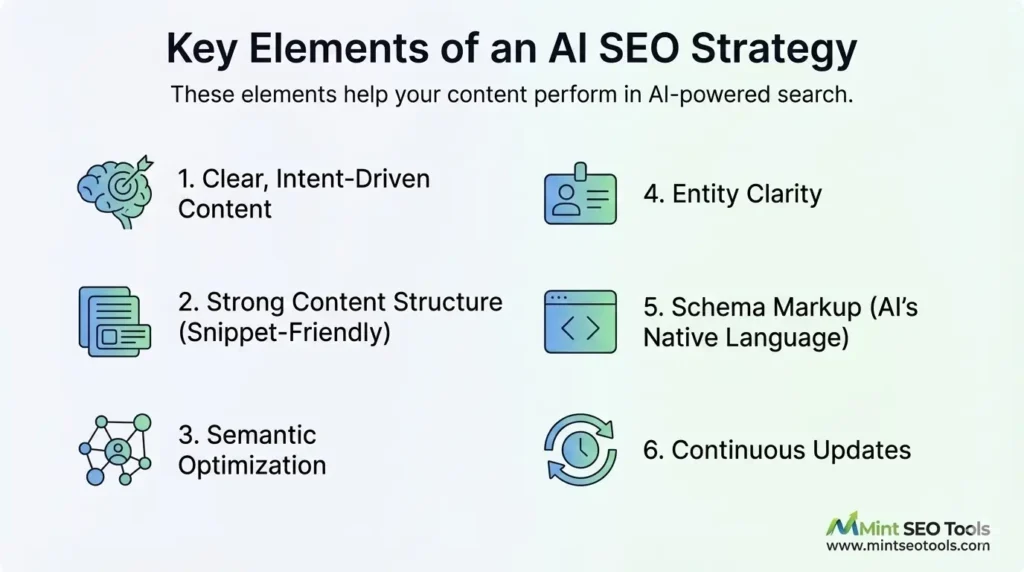
1- Clear, Intent-Driven Content
Start with the user’s question.
Answer it:
- Directly
- Clearly
- Completely
AI prefers content that gets to the point fast.
2- Strong Content Structure (Snippet-Friendly)
Use:
- One clear H1
- Logical H2 and H3 sections
- Short paragraphs
- Bullet lists
- FAQs
This makes content easy for AI to extract.
3- Semantic Optimization
Cover related ideas naturally:
- Definitions
- Examples
- Use cases
- Supporting concepts
This signals topical depth.
4- Entity Clarity
Make it obvious:
- Who you are
- What you offer
- What topics you’re an expert in
- Why your content is trustworthy
Entities build AI trust.
5- Schema Markup (AI’s Native Language)
Schema helps AI understand your page.
Recommended schema:
- Article
- FAQPage
- HowTo
- Organization
Schema increases eligibility for AI Overviews and rich results.
6- Continuous Updates
AI models evolve.
Search behavior changes.
Regular updates keep your content relevant and visible.
AI SEO vs Traditional SEO (Quick Comparison)
Traditional SEO focuses mainly on ranking pages in search results by optimizing keywords, backlinks, and technical factors. The goal is to appear higher in the SERPs and drive clicks to a website.
AI SEO, on the other hand, focuses on helping search engines and AI systems understand, trust, and reference content. Instead of optimizing only for rankings, AI SEO optimizes for intent clarity, semantic depth, structured data, and entity recognition so content can be cited in AI Overviews, featured snippets, voice answers, and generative search results.
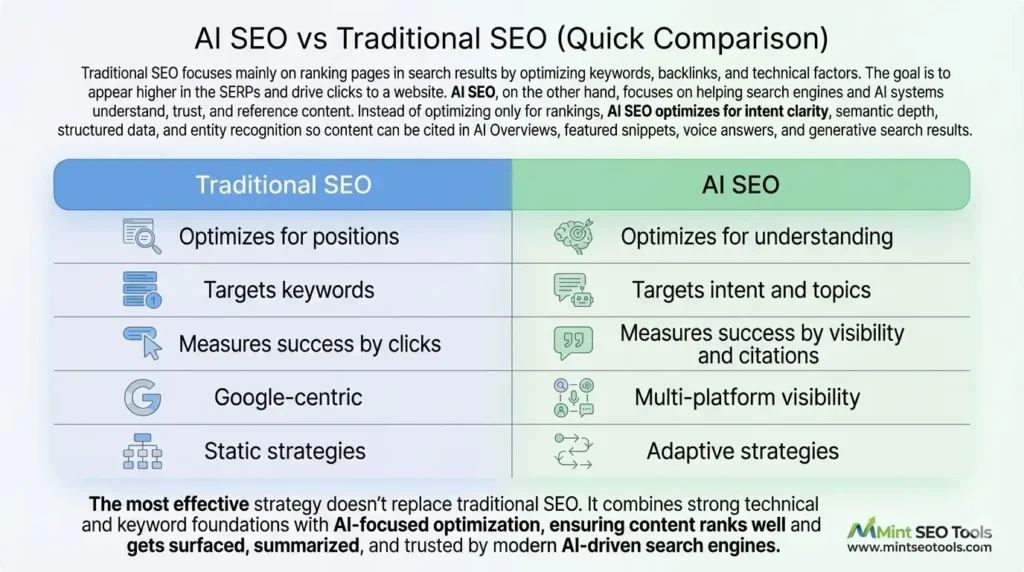
Key differences:
- Traditional SEO optimizes for positions; AI SEO optimizes for understanding
- Traditional SEO targets keywords; AI SEO targets intent and topics
- Traditional SEO measures success by clicks; AI SEO measures success by visibility and citations
- Traditional SEO is Google-centric; AI SEO works across multiple AI-powered platforms
The most effective strategy doesn’t replace traditional SEO. It combines strong technical and keyword foundations with AI-focused optimization, ensuring content ranks well and gets surfaced, summarized, and trusted by modern AI-driven search engines.
The Role of Trust in AI SEO
AI systems prioritize content that shows:
- Accuracy
- Consistency
- Expertise
- Clear sourcing
Trust is the new ranking factor.
What the Future of AI SEO Looks Like
Search will continue to move toward:
- Voice-based queries
- Conversational answers
- Predictive results
- Entity-driven rankings
In this future, brands that educate AI clearly will dominate visibility.
AI SEO Best Practices (Quick Checklist)
- Answer questions directly
- Use clear headings
- Write simple, helpful content
- Build topic clusters
- Use schema markup
- Optimize for AI extraction
- Update content regularly
Conclusion: Why AI SEO Is the Future of Search
AI SEO isn’t about gaming algorithms.
It’s about:
- Helping users
- Teaching machines
- Communicating clearly
To win in modern search, you must:
- Understand user intent deeply
- Create structured, high-value content
- Optimize for AI visibility
- Combine human expertise with AI tools
AI SEO is how you stay visible — not just ranked — in the AI-driven era of search.

- What Is a Google AI Overview? The SEO Survival Guide (2026) - February 3, 2026
- How Search Engines Use AI to Rank Content: The 2026 Deep Dive - January 27, 2026
- What Is AI SEO? The Complete Guide to Ranking in AI-Powered Search (2025) - December 21, 2025
Give me the latest news!
Looking for SEO tips? Subscribe to our newsletter to receive updates on the content you care about.