Key Takeaways
- Definition: Topical Authority is the depth of expertise your site demonstrates on a subject, measured by semantic coverage and content interconnectedness.
- The Science: It relies on Google’s “Vector Space” analysis, where related concepts are mapped in 3D clusters.
- Measurement: Use the “Topic Share” method—calculate what percentage of total search volume your site captures for a specific keyword cluster.
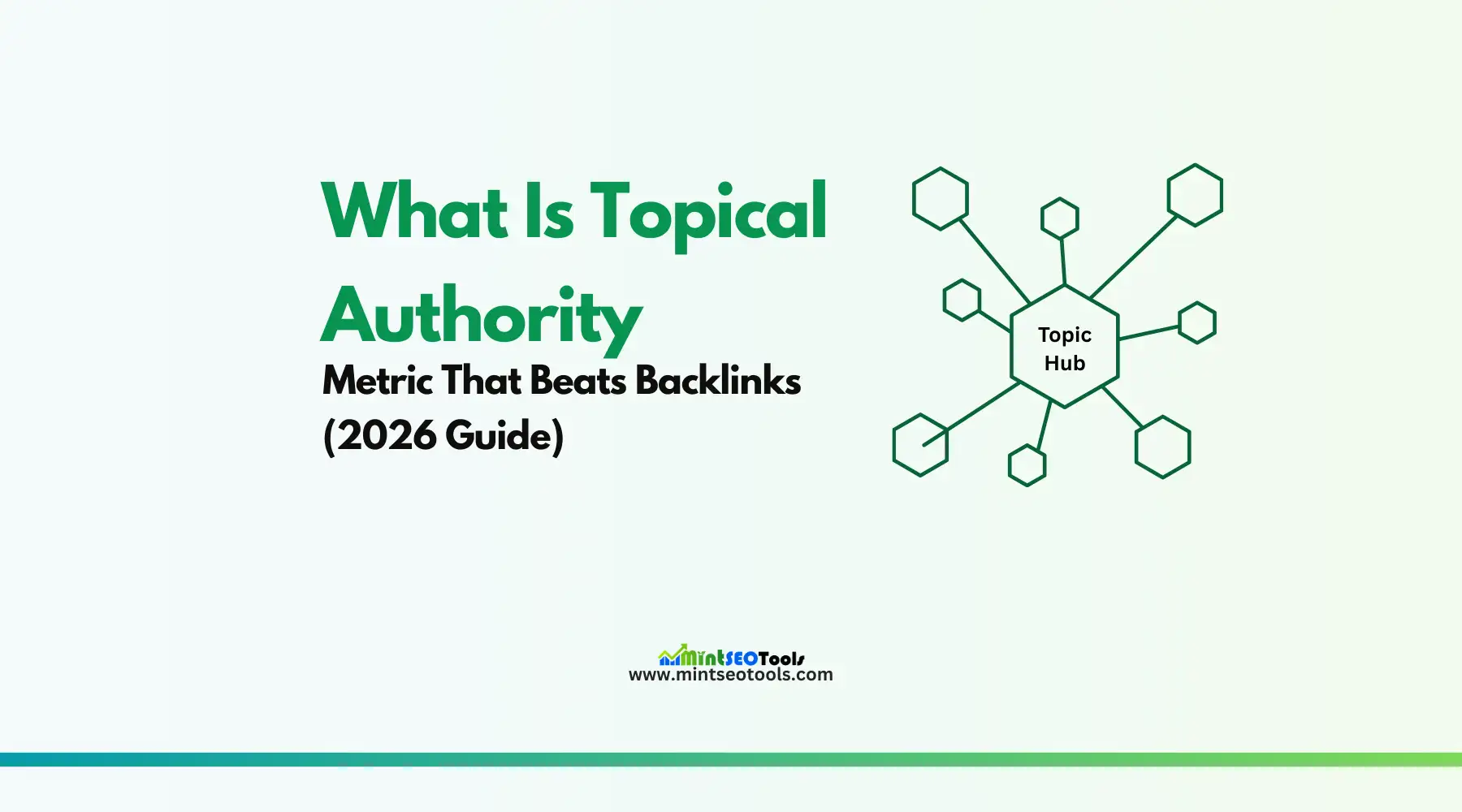
- Strategy: Use the Pillar-Cluster model. Create one massive hub page and support it with 10-30 specific spoke pages.
- The Edge: While competitors chase backlinks, you can win by answering the “zero volume” questions that prove true expertise.
In the early days of SEO, whoever had the most backlinks won. Today, the game has changed. You can no longer brute-force your way to #1 by throwing links at a thin 500-word article. Google’s algorithms now prioritize a different signal: Topical Authority.
If you have ever wondered why a small, niche blog with a Domain Authority (DA) of 20 can outrank a giant like Forbes or Wikipedia, the answer is topical authority. It is the single most important factor for ranking in the era of AI Overviews and semantic search.

What Is Topical Authority?
Topical authority is a measure of a website’s depth of expertise on a specific subject. It signals to search engines that a site is a trusted “go-to” resource for a particular niche because it covers not just the main keywords, but every related sub-topic, user question, and semantic entity within that field.
Think of it this way: Domain Authority measures how popular your site is (based on votes/links from others). Topical Authority measures how smart your site is (based on the depth of your content).
When you achieve high topical authority, Google essentially “unlocks” rankings for your entire site. Instead of fighting for every single keyword, your new articles rank almost instantly because the algorithm already trusts your expertise in that vector space.
Topical Authority vs. Domain Authority
Many SEOs confuse these two metrics. Here is the distinct difference:
| Feature | Domain Authority (DA/DR) | Topical Authority |
|---|---|---|
| Primary Driver | Backlinks (External validation) | Content Depth (Internal expertise) |
| Scope | Site-wide power | Niche-specific power |
| Ranking Impact | Helps rank for high-competition terms | Helps rank for long-tail & semantic terms |
| Dependency | Requires other sites to link to you | You control it 100% |
The Science: How Google Measures Expertise
Topical authority isn’t just a theory; it is rooted in Google’s patent history and engineering. To understand how to build it, you must understand how Google “reads” your site.
The “Website Representation Vectors” Patent
In a landmark patent titled “Website Representation Vectors,” Google describes a system that classifies websites into “knowledge domains.”
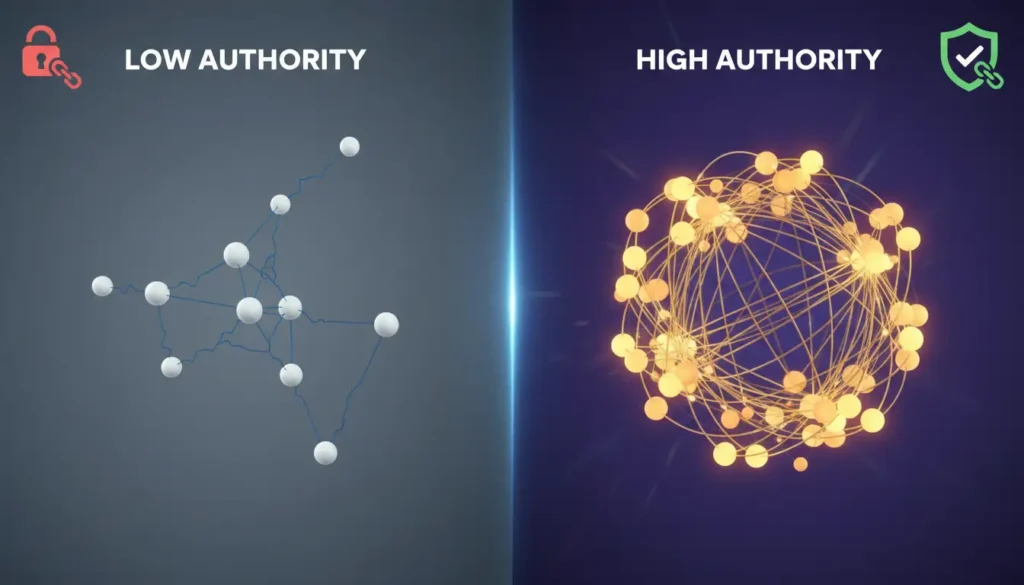
Imagine a 3D graph. Every concept in the world, “Coffee,” “Roasting,” “Beans,” “Espresso”, exists as a point in this space. If your website only talks about “Coffee,” you are a small dot. But if you also cover “French Press techniques,” “Arabica vs. Robusta,” and “Best Grinders,” your dots form a dense cluster.
Google’s algorithm calculates the vector distance between your content and the “center” of that topic. The closer and denser your cluster, the higher your topical authority. This is why “thin” content fails, it creates a weak, scattered vector signal.
Entities Over Keywords
Modern SEO is about Entities, not just keywords. An entity is a distinct thing (person, place, concept) that Google understands.
- Old SEO: Repeating “best running shoes” 10 times.
- Topical Authority SEO: Discussing “arch support,” “EVA foam,” “pronator,” “marathon training,” and “Nike” in relation to running shoes.
By connecting these entities, you prove to the search engine that you understand the context of the topic, not just the vocabulary.
How to Measure Topical Authority
This is the hardest part for most SEOs because tools like Ahrefs or Semrush do not have a “Topical Authority Score.” However, you can calculate it manually using the Traffic Share method.
Topical Authority is measured by calculating your “Market Share” of traffic for a specific cluster of keywords compared to your competitors.
Method 1: The “Traffic Share” Calculation
Follow this workflow to audit your authority on a specific topic (e.g., “CRM Software”):
- Define the Cluster: Go to a keyword research tool and export all keywords related to your topic (e.g., all keywords containing “CRM”). Aim for a list of 500-1,000 keywords.
- Get the Total Search Volume: Sum up the search volume of all these keywords. Let’s say the total monthly volume is 100,000 searches.
- Check Your Traffic: Filter your own site’s ranking report to see how much traffic you get specifically from this list of keywords.
- Calculate the Percentage: (Your Traffic / Total Cluster Volume) * 100 = Your Topic Share.
If you capture 0.1% of the traffic, you have low authority. If you capture 10-20%, you are a topical leader.
Method 2: The Keyword Depth Ratio
Another way to measure authority is by looking at the ratio of ranked keywords per page.
- Low Authority Site: A page ranks for 10-20 keywords.
- High Authority Site: A single page ranks for 500+ long-tail variations and semantic queries.
You can check this in Semrush or Ahrefs by looking at the “Keywords” column in the “Top Pages” report. If your numbers are rising across the board, your topical authority is growing.
How to Build Topical Authority (4-Step Blueprint)
Building authority is not about writing more content; it is about writing connected content. You need to build a “Knowledge Graph” on your own site.
Step 1: Entity Mapping (The “Zero” Phase)
Before you write a single word, you must map the territory. Do not just look for high-volume keywords. Look for the logical structure of the topic.
Use a tool like Google Trends or AnswerThePublic to find:
- Core Concept: The main topic (e.g., “Solar Panels”).
- Sub-Topics: “Installation,” “Cost,” “Types,” “Maintenance.”
- Questions: “Are solar panels worth it?”, “How long do they last?”
Your goal is to find content gaps, questions your competitors have failed to answer thoroughly.
Step 2: The Pillar-Cluster Architecture
Organize your content into a Hub-and-Spoke model. This is non-negotiable for topical authority.
The Pillar Page (The Hub)
This is your “Ultimate Guide.” It covers the broad topic at a high level. It should be long (3,000+ words) and touch on every aspect of the subject, linking out to specific sub-pages for details.
The Cluster Pages (The Spokes)
These are specific, deep-dive articles. If your Pillar is “Solar Panels,” your spokes are:
- “Monocrystalline vs. Polycrystalline Panels”
- “Solar Panel Tax Credits in 2026”
- “Best Solar Batteries for Home Storage”
Each spoke targets a specific long-tail intent and links back to the Pillar.
Step 3: Semantic Internal Linking
Internal linking is the nervous system of your website. It tells Google how pages relate to each other.
The Rule of 3 Links:
- Vertical Link: Link from the Spoke back to the Pillar (Anchor text: “Solar Panels Guide”).
- Horizontal Link: Link from one Spoke to a related Spoke (e.g., “Tax Credits” linking to “Cost of Installation”).
- Contextual Link: Link to an external authority (like a .gov site) to cite data.
This web of links creates a dense vector cluster that is hard for competitors to break.
Step 4: The “Update Rate” Signal
Google’s “Query Deserves Freshness” (QDF) algorithm rewards up-to-date content. Topical authority is not a “set it and forget it” metric. You must regularly update your old content with new stats, years (2025 to 2026), and recent examples.
Pro Tip: Update your Pillar page every 3-6 months. This sends a “freshness” signal down to all linked cluster pages.
3 Common Mistakes Killing Your Authority
Even with good content, technical errors can drain your authority score.
1- Keyword Cannibalization
This happens when you write two articles about the same thing (e.g., “Best SEO Tips” and “Top SEO Strategies”). Google gets confused about which one to rank, and often ranks neither. Fix: Merge them into one authoritative guide.
2- The “Orphan Page” Problem
An orphan page is a page with no internal links pointing to it. If Google’s crawler cannot find a path to the page, it assumes the page is unimportant. Always link new content from existing high-traffic pages.
3- Ignoring “Zero Volume” Keywords
Many SEOs ignore keywords with 0-10 monthly searches. This is a mistake. These hyper-specific queries are often the “glue” that holds a topic together. Answering them proves you are a true expert who knows the niche details, not just a content farm chasing volume.

FAQ’s
How long does it take to build topical authority?
Building topical authority typically takes 3 to 6 months of consistent publishing. For highly competitive niches (like finance or health), it may take 6-12 months to fully saturate a topic cluster and overtake established competitors. The key variable is “velocity”, how fast you can publish high-quality, interlinked content.
Can a low DA site rank with high topical authority?
Yes. Google’s “Helpful Content” systems prioritize expertise over raw link power. A site with a Domain Authority (DA) of 20 can outrank a site with DA 80 if the smaller site covers the specific topic with greater depth, semantic connectivity, and user satisfaction. This is often called “niche dominance.”
Is topical authority more important than backlinks?
In the modern SEO landscape (post-2024), topical authority is often the prerequisite to ranking, while backlinks act as a multiplier. Without topical authority, backlinks yield diminishing returns because Google doesn’t trust your site’s relevance. Therefore, for new sites, building topical authority is more important to establish first.

- What Is Topical Authority? The Metric That Beats Backlinks (2026 Guide) - February 20, 2026
- What Is a Google AI Overview? The SEO Survival Guide (2026) - February 3, 2026
- How Search Engines Use AI to Rank Content: The 2026 Deep Dive - January 27, 2026